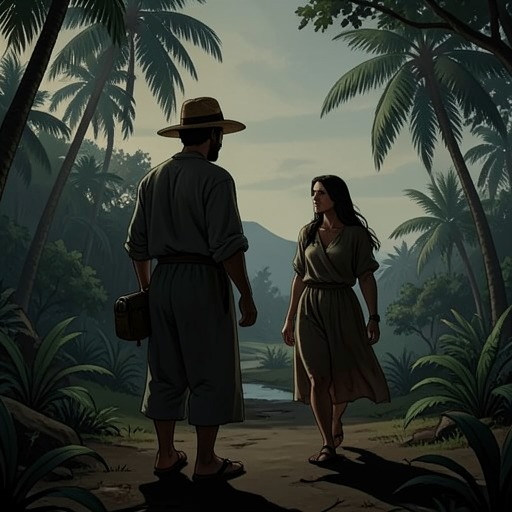
Orixás
Foucault's PendulumThe Orixás are African divinities associated with Afro-Brazilian religions, especially candomblé, and with the syncretic religious landscape that Casaubon encounters in Brazil. In the umbanda ceremony he witnesses, they do not appear as the spirits possessing the mediums: they remain in the background, joined in the religious imagination with Catholic saints. Yet the novel makes their absence a charged presence. Amparo believes she has rejected them, but the rite exposes how much of the world they represent still lives within her.
Religious Context and Ritual Role
Casaubon first encounters the Orixás through the political arguments of Amparo’s comrades. Their discussions of class struggle turn unexpectedly to Afro-Brazilian religions and the place of Indigenous and African practices in Brazil. The comrades disagree about what these cults mean: some see a return to cultural roots and resistance to the white world; others regard them as an opiate that diverts revolutionary energies; still others describe them as a mixture of white, Indigenous, and Black traditions without agreeing on its purpose. The Orixás belong to a religious world that none of these interpretations can reduce to a single political function.
Amparo takes a sharply anti-religious position, treating religion as an opiate and pseudo-tribal cults as worse still. At the same time, she throws herself into the samba-school world with her whole body. She later denounces carnival devotion and soccer rituals as forms of enchantment that absorb the disinherited’s energies, but her own participation complicates that certainty. The Orixás therefore enter the story not only as objects of belief but as part of a cultural inheritance that intellectual conviction cannot simply cancel.
The distinction between candomblé and umbanda clarifies how the Orixás operate in the ceremony. Aglie explains that candomblé mediums are possessed by the Orixás, whereas the umbanda session Casaubon is about to attend is associated with the Eguns, spirits of the departed, and with Exu. In this account, the African Orixás remain in the background, syncretized with Catholic saints; the spirits of the dead are the beings who intervene and produce the trance. The Orixás are thus present within the religious system without being the immediate agents of possession in this particular rite.
The Umbanda Ceremony
The ceremony takes place in a crowded, brightly colored hall organized around an altar and a space for the dancing mediums. Its figures include Pretos velhos, Caboclos, and oversized images of Catholic saints; Casaubon notices Saint George, Saints Cosmas and Damian, a Virgin pierced by swords, and a vividly rendered Christ. There are no images of the Orixás, but their presence is sensed among the worshippers and in the atmosphere surrounding the impending gira. Their place is at once backgrounded and felt, a pattern that mirrors the account of their religious role.
The pai-de-santo receives worshippers near the altar, blessing them and offering liquor, while the atabaques beat and the initiates sing to Exu and Pompa Gira. He swings a thurible and chants prayers to Oxalá and Nossa Senhora. This pairing makes the ceremony’s religious mixture concrete: African divinities and Catholic figures inhabit the same ritual environment. The Orixás are not the beings visibly taking control of the mediums, yet the rite’s arrangement and prayers keep their tradition in view.
As the drums quicken, the mediums move before the altar and some enter trance. Casaubon observes that the possessed participants’ movements differ according to the beings understood to be acting through them. A German psychologist, despite years of participation, never enters trance; other women do. The contrast makes possession a particular experience within the rite rather than a state all participants can summon at will. It also shows why the Orixás should not be conflated with every spirit present: the umbanda ceremony distinguishes among the Orixás, the spirits of the departed, and the Catholic figures woven into its practice.
Amparo and Embodied Memory
Amparo’s response gives the Orixás their most intimate significance in the episode. During the drumming and dance, her hands sweat, her body trembles, and she says she feels ill and wants to leave. Outside, she attributes her reaction to food, smells, and heat. The pai-de-santo, however, tells her that she has the qualities of a medium and that he had been watching her respond to the pontos. Amparo angrily rejects his claim, insisting that she was merely sick and asking to be left alone.
Later, Aglie interprets what happened as a return of something Amparo had tried to suppress: the Orixás she had destroyed in her heart still live in her womb. His statement is an interpretation, not a neutral demonstration that her reaction proves possession. The scene keeps distinct the pai-de-santo’s authority as a ritual observer, Amparo’s own refusal of his explanation, and Aglie’s broader theory of unconscious cultural inheritance. What is clear is that the ceremony unsettles the boundary Amparo had drawn between her political identity and the religious stories she heard from her grandmother.
That disruption becomes explicit in Amparo’s recollection that she had forgotten her own country and race, and the stories of her grandmother, under the influence of Europe and historical materialism. The Orixás consequently signify more than a set of divine figures: they mark a remembered cultural world that can persist beneath conscious disbelief. The novel does not settle the tension by declaring Amparo a medium. Instead, it places her embodied reaction beside competing accounts—religious, political, and psychological—and lets the unresolved contradiction carry the force of the encounter.
Significance
The Orixás belong to a Brazilian religious landscape shaped by overlapping traditions, migration, and competing interpretations of cultural identity. Earlier, Amparo’s comrades debate whether Afro-Brazilian cults resist white culture, distract the oppressed, or blend different populations; at the umbanda session, the layered altar and the distinction between Orixás, spirits, and saints give that debate a lived ritual form. The religious world is not simply a symbol waiting to be absorbed into the novel’s European esoteric schemes.
Aglie’s account, meanwhile, treats inherited culture as something that may remain active in the unconscious even after conscious repudiation. His argument makes Amparo’s body an apparent site of memory, but his language also reveals his own interpretive authority: he explains what her experience means, while she protests that she is unwell and wants privacy. This imbalance matters. The episode allows the Orixás to connect religious practice with cultural inheritance without making the narrator’s observation, the priest’s claim, or Aglie’s theory interchangeable.
The ceremony also complicates the novel’s recurring contrast between mystical experience and initiation. Aglie distinguishes the public, conspicuous state of possession from the secret, disciplined transformation he associates with initiation. The Orixás belong to the former ritual field in this discussion, but the novel renders that field through a specific Afro-Brazilian setting, with its own participants, music, figures, and categories. Their significance lies partly in resisting a single explanation: they are divine beings within a religious tradition, elements of a syncretic rite, and—through Amparo’s conflict—an inheritance that remains difficult to dismiss.